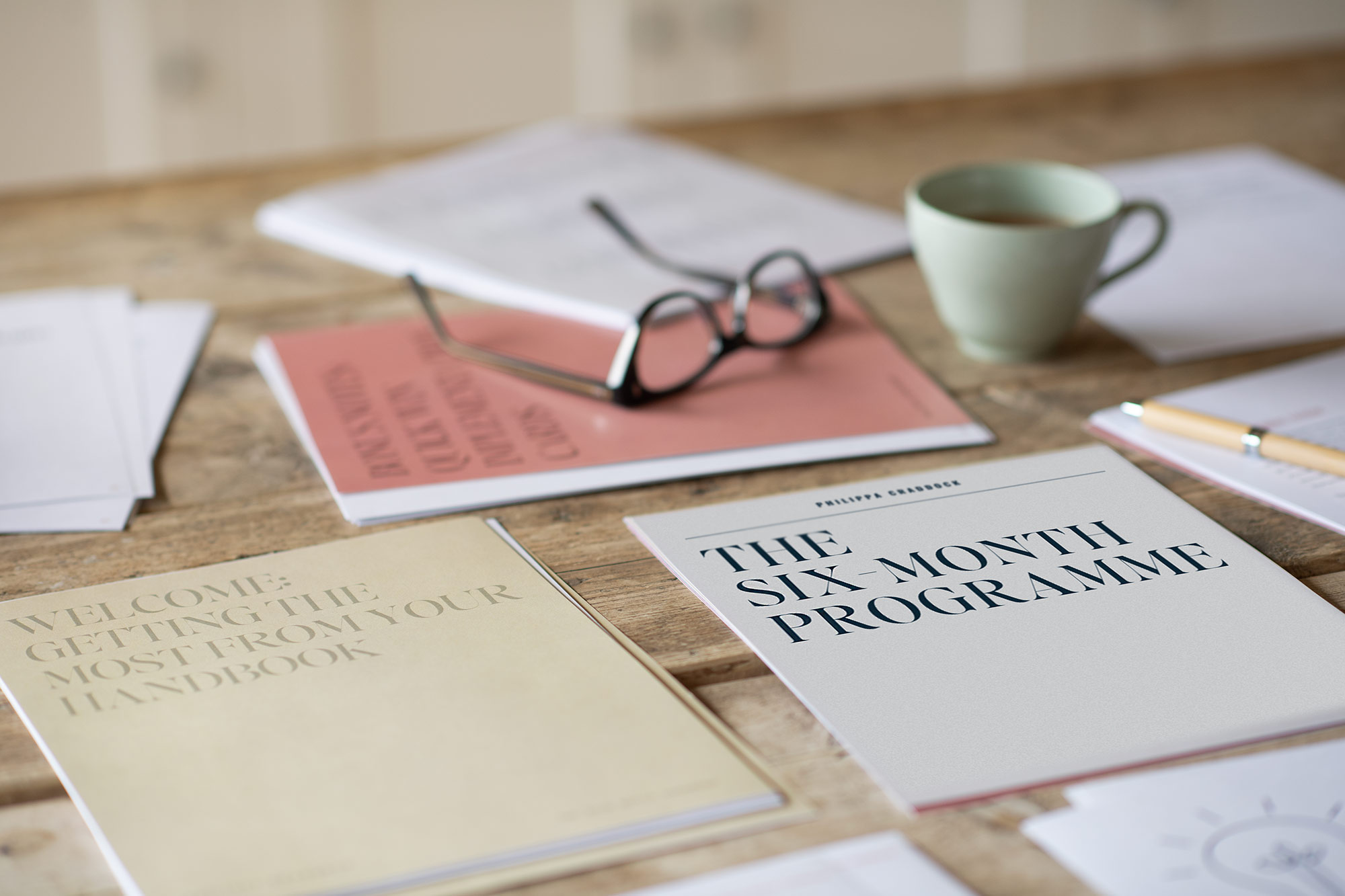

The Bright Line has been running properly since mid-February. About three months in, the community hub has become the thing I check first in the morning. I love it. Real conversations, real questions, properly thoughtful work happening on real businesses. I reply in detail to every post personally, usually same-day, because that’s part of how the programme works and part of why I love it.
And over those months, I started to notice something. The same patterns of question kept showing up. Not in the same words exactly, but in a similar shape. In the community hub, in our live coaching sessions, and in private DMs that came through to me.
These were people in very different creative businesses, also at very different stages, but the underlying shape was similar. People were doing the work, properly, and at certain points they were getting stuck. Not because they couldn’t do what was being asked of them. But because there was a layer of support they needed at those specific points that I hadn’t quite built in yet.
And as I sat really listening, answering questions and watching the patterns build over time, I started to see something quite important. The questions were telling me exactly where the work needed to go deeper. They were a map, in a way. They were showing me where to build in more support, what to clarify, what to add.
So I went back to GATHER, the very first segment of six inside The Bright Line, and rebuilt it. Properly. The original was already doing real work for people; that wasn’t the issue. What the underlying questions were telling me was where the teaching needed to go deeper. So that’s what I followed.
The rebuild
I want to share a little of what that actually looked like, because I think it’s relevant to what we’re going to get to about your own business.
I sat with every recurring question. I went back through coaching sessions and looked at where my own answers were really helping, and where I was having to work harder to help someone through. I asked myself, again and again: what would have made this easier for them? Where exactly are people getting stuck, and why? What’s missing from how I’ve structured this work?
From all of that thinking, I rebuilt the whole pillar. Not a tweak. A proper, proper rebuild. New layers and new structure. New tools to bring everything together. I redesigned the order of how the work moves. I added support exactly where I’d seen people getting stuck. I made it deeper, and easier to actually do.
It took weeks. Drafting, redrafting, testing, going back. Asking myself every time: is this clearer? Will this work for someone in the middle of running a really busy business, with limited time? Will it actually make a real difference?
I’ve also been making other changes across the wider programme. New 1:1 monthly check-ins. Other elements that participants will see as they work through the material. It’s exciting to see how the whole of The Bright Line is evolving, and to be able to offer the support that’s really needed.
I’m not sharing this to make a point about the work itself. I’m sharing it because I want you to feel what’s possible when you really listen. Every single change in the new GATHER came from a question someone had asked. Every decision about what to add and where to add it came from watching what people had needed. The programme is genuinely better now, and it’s better because of what they told me, often without realising they were telling me anything at all.
The wider thing
What’s happened with GATHER over the last few months is the story of a practice I think every creative business needs to be doing.
It’s the practice of listening. Really listening and paying attention. And using what you hear to evolve your offerings, your work, the way you do what you do.
Because what I really want you to hold onto today, whatever kind of business you run:
You cannot fully see your own work from inside yourself alone.
There are things about your work and your offerings that you cannot easily see from inside the business. Where they’re working brilliantly. Where there’s an element of friction. Where people are quietly asking for more. You’ve been living inside the day-to-day of it all, often for years, to the point those signals don’t register. To you, they’re just… well, how things are.
But the people who experience your work, the people who choose you, who come back, who recommend you, who pay you, they see those things crystal clearly. They’ve been telling you for years, often without you even realising. Often in words that don’t even sound like feedback in any sense. They sound like generous comments, or kind throwaway lines, or something somebody’s just being polite and kind about. Or, on the opposite side, it might be an element of frustration. People not quite realising it could be better. Their questions are signalling exactly that, if you pay close attention.
And learning to read what they’re telling you, properly, is one of the most strategically valuable skills you can develop as a creative entrepreneur. Not just for positioning or marketing, but actually for everything. For how you build your offerings. For how you price. For who you market to. For the parts of your work you choose to develop further. All of it gets clearer when you start really listening to what the people who experience your work are telling you.
The practice
So how do you actually do this? It looks slightly different depending on your business. Some of us are working with clients in a really direct way, with lots of contact, lots of conversation, lots of opportunity to ask and listen. Others have businesses where the customer interaction is lighter, or more transactional, or happens at more of a distance. Both kinds of business can build this practice. The underlying work is the same.
The first move, and the most overlooked, is to read what’s already there. Most of you already have more evidence than you realise. Thank-you messages. Testimonials. The notes clients have sent over the years. Repeat clients, and what brought them back. The reasons people have referred you. The questions that have come up in DMs and emails again and again. You’ve probably read these as warm moments and moved on, or perhaps they have been a little more constructive. Go back to them. Read them with a different question in mind. What are these people actually telling me about my work? What are they thanking me for beyond the deliverable I was paid to make? What are they asking me for that isn’t quite there yet?
The second move is to ask. Properly. Specific questions that surface what people actually noticed. Why did you choose me, specifically, rather than someone else? What worked for you about how we did this together, or what did you love most about the product and the ordering process? What would you have wanted more of? What’s the thing you’d say to a friend if you were recommending me? Those are the questions that get you something worth having. The generic “how was the experience” kind of ask tends to get you generic feedback, which is lovely but doesn’t actually help you see what’s true.
Now, I know how this can feel. Asking for feedback can feel uncomfortable. It can feel a little self-indulgent, even seriously exposing. Like you’re inviting criticism, or fishing for compliments, or admitting you don’t know your own work. I’d love to gently reframe that for you. When it’s done thoughtfully and well, asking for feedback is real ownership. You are the person responsible for this work in the world. You owe it to your work, and to the people you serve, to see it as clearly as you can. And you can’t see it clearly from solely inside yourself.
There’s something quite lovely and quietly bold about it. People want to help. People want to be asked. They feel valued when their opinion matters to you. Most are quietly waiting for someone to invite their thoughts properly, and when you do, they’ll give you something properly useful.
There’s a third move that sits underneath all of these. Listen for what you weren’t expecting. The thing somebody says that surprises you. The friction point you’d never quite noticed. The compliment that doesn’t sound like something significant because it sounds so ordinary. The thing somebody asks for that you’d never thought to offer. Those are the moments to slow down on, and the threads really worth paying attention to and following.
You can do this whether you make wedding flowers or design buildings, whether you photograph portraits or write strategy, whether you run a tea brand or coach business owners. The medium doesn’t change the principle. The businesses I’ve watched become exceptional are the ones where the founder has built a quiet, ongoing practice of listening. Not asking for praise. Not surveying for the sake of surveying. Just paying proper attention. Reading the unprompted words. Noticing what people return for. Catching the offhand comments. Looking for the patterns underneath the questions.
Where this leads
Your business will get better when you let other people show you what they’re experiencing in your work. They can see things you can’t. The friction points, the questions, the things they’re quietly asking for, the things they keep coming back for. You just possibly can’t see all of it yet from inside. But other people can. And they want to tell you. They want to be asked. And what you do with what they tell you is what makes your work really start to evolve.
Always growing. Never stagnant. Always more itself, more aligned with what you actually love doing and what your audience genuinely needs.
It’s a properly phenomenal way to run a business. And underneath all this listening sits the kind of thinking I do with creative business owners in The Missing Piece, the live conversation that runs before The Bright Line. We sit with someone’s own work and their own offerings, and start to see what’s actually there. Often what’s been quietly hiding in plain sight.
Your work gets better when your listening gets better. It becomes clearer. It becomes more enjoyable. It becomes properly yours.
That’s it. That’s the whole thing.
Comments +